
News
Sustainable Bioenergy Cropping Systems
Zooming in: Studying soil at the microscopic level to solve big problems
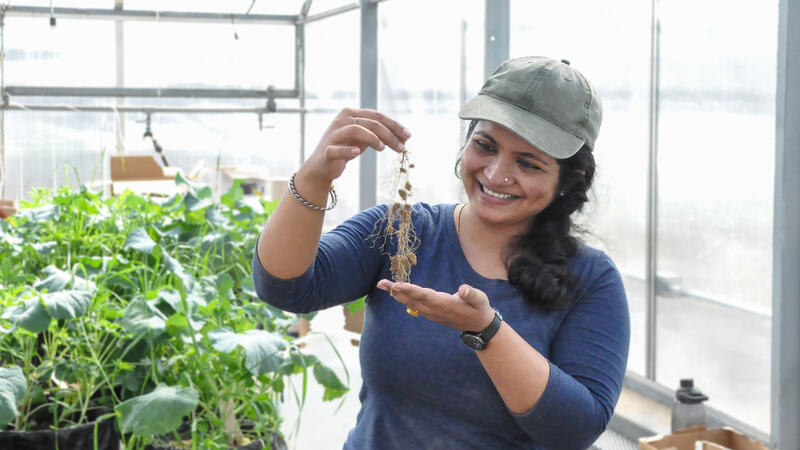
Since joining the Great Lakes Bioenergy Research Center in 2022, Poulamee Chakraborty has authored papers on the legacy of agricultural management practices on switchgrass growth and soil carbon gains, the ways soil pores affect microbial oxygen consumption, and the soil carbon impact of plants engineered to accumulate readily-accessible carbohydrates.
Bacteria and other microbes can convert plant fibers into sustainable fuels and chemicals used to make plastics, medicines, and other products. But chemicals used in processing or in the plants themselves are an obstacle because they can kill the cells or slow fermentation. Researchers are looking for ways to modify natural efflux pumps to selectively remove these toxins, but testing the vast number of possible variations is impractical using traditional lab techniques. Data generated for this project are being used to train artificial intelligence models to predict which mutations are most likely to be effective.
An autonomous experimentation platform at the Great Lakes Bioenergy Research Center is poised to accelerate discoveries that will harness the power of microbes to advance U.S. leadership in the developing bioeconomy. With the ability to design and run multiple concurrent experiments, Proteus expands the scope and pace of exploration, potentially increasing the rate of discovery.
Switchgrass and miscanthus are considered good bioenergy crops. They can grow on lower quality lands not used for food production, add carbon to the soil, and be converted into fuels and chemicals traditionally made from petroleum. Scientists have observed that these grasses produce high yields for a few years and then begin to decline; but they don’t fully understand why that happens. Using data from bioenergy crop experiments in Michigan and Wisconsin, scientists with the Great Lakes Bioenergy Research Center analyzed more than 200 plantings of switchgrass and miscanthus to better understand long-term yield patterns and what drives them.
Microbes devour plant material, like leaves and stems from native plants, and convert it into biofuels and bioproducts. But in the process, the deconstructed plant material releases toxins that get in the way, creating one of the challenges to making biofuels an efficient and economical alternative to existing fuels. GLBRC co-investigator Jason Peters and his team are building tools to help make the microbes more resilient.
Traditionally scientists grow “libraries” of mutants — pools of cells with different genes turned off — in the presence of a chemical. Analyzing the surviving cells can provide clues about which genes allow the microbe to tolerate that chemical. But using only one screening method tends to produce false positives, requiring slow and labor-intensive follow-up experiments.
To solve the problem, scientists used two genome screening techniques with complementary strengths and weaknesses to study the effects of inhibitory chemicals on Zymomonas mobilis, a promising microbe for industrial production. Applying the dual-library approach narrowed the field of candidate genes by two thirds. Genes selected for follow-up tests were all true positives.
Building on previous work evaluating stepwise processing, scientists with the Great Lakes Bioenergy Research Center sought to improve the results with a biorefinery design that combines the first two steps, separating lignin from sugars and breaking into useable pieces with the help of a metal catalyst.
Scientists evaluated how switchgrass responded to drought stress at distinct stages of development — vegetative growth, flowering, and when leaves and shoots die off in the fall (senescence) — and the effects on fermentation of plant sugars. The findings suggest that the timing of drought stress has little impact on plant size but does change fermentation rates. Drought during the growing stage can make plants more hardy at the expense of biofuel production, while late-season drought enhances ethanol yields.
Scientists with the Great Lakes Bioenergy Research Center published 94 peer-reviewed journal articles in the past year. These are some of the most notable discoveries and innovations providing foundational knowledge to enable economically and environmentally sustainable production of biofuels from non-food crops.
University of Wisconsin–Madison scientists have developed a new method for efficiently pinpointing genes that help microbes resist toxic chemicals, which could enable innovations in biotechnology, medicine, and agriculture.
Over millions of years, plants have developed ways to protect themselves. For example, plants produce special chemicals, or metabolites, to combat harmful microbes, especially fungi. But those same metabolites can make it harder for biorefineries to ferment the plant sugars into fuel or other products with yeast, a type of fungus.


