
Autonomous lab accelerates discoveries to harness power of microbes
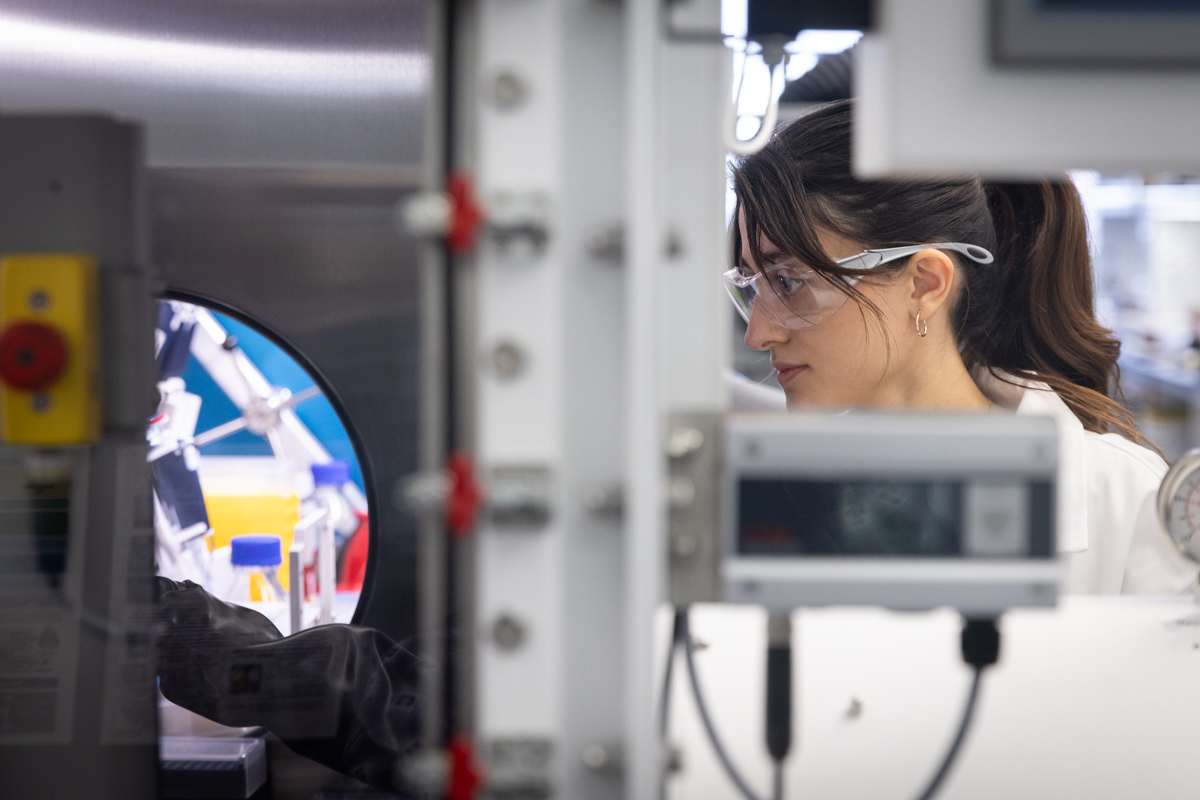
An autonomous experimentation platform at the Great Lakes Bioenergy Research Center is poised to accelerate discoveries that will harness the power of microbes to advance U.S. leadership in the developing bioeconomy.
The AI-enabled platform, known as Proteus, will enable researchers to make quicker, smarter decisions when engineering microbes for biomanufacturing, including development of bio-based fuels, chemicals, and other products.
With the ability to design and run multiple concurrent experiments, Proteus expands the scope and pace of exploration, potentially increasing the rate of discovery.
“Proteus allows us to explore multiple strategies with a high degree of precision simultaneously,” said Michael Botts, director of the BioAutomation Lab on the University of Wisconsin–Madison campus.
Coupled with machine learning and artificial intelligence, Proteus will be a self-driving lab capable of iterative design-test-learn cycles to help researchers develop and test hypotheses from large data sets, allowing scientists to explore more lines of investigation.
“We see enormous potential for Proteus to generate data to support an AI-driven bioeconomy,” said center Director Tim Donohue. “Proteus will accelerate innovation and help us both obtain the breakthroughs and train the future leaders of a biotechnology revolution.”
As the administrative home of Great Lakes Bioenergy for the past 19 years, UW–Madison is well positioned to leverage Proteus in partnership with national laboratories and DOE’s Genesis Mission to dramatically increase biological research productivity.
“Department of Energy programs in genomics, structural biology, and computing have made significant discoveries that have revolutionized our understanding of living systems,” said Dorota Grejner-Brzezinska, UW–Madison’s vice chancellor for research. “As an AI-enabled platform, Proteus will help scientists rapidly acquire the volume of high-quality data needed to ensure the United States continues to lead biotechnology innovation.”

GLBRC scientists will use Proteus to understand the relationship between microbial genetics and how the microbes respond to industrial conditions, nutrients, and toxins. With this data, they can engineer new strains that turn plant biomass and waste streams into fuels and chemicals used to make plastics, cosmetics, medicine, and other value-added products.
Generating data for an AI-powered bioeconomy
Microbes have been performing chemistry longer than people. They are essential to the survival of plants, animals, and humans, and can provide catalysts for the emerging bioeconomy. Their genomes encode millions of uncharacterized proteins that can be mixed, matched, and modified to generate fuels and other industrial products from biomass.
Tapping this genetic and chemical potential requires both speed and breadth of experimentation. Combining automation and artificial intelligence, Proteus is a power tool for mining these microbial genomes.
Designed and built by Gingko Bioworks, Proteus combines liquid handler, incubator, plate reader, and storage components to automate workflows in both anaerobic and aerobic environments. Scheduling software can be programmed to handle multiple protocols without the need to reconfigure setups. Results are automatically streamed to the center’s data catalog for real-time analysis by researchers and as training sets for machine learning.
Proteus will help researchers engineer microbes to power bio-based production of fuels, chemicals, and materials and optimize microbe-plant interactions to ensure food productivity and security.

GLBRC co-investigator Jason Peters, UW–Madison professor of pharmaceutical sciences, is using Proteus to test thousands of bacterial genetic variants supplied with hundreds of treated bioenergy crop samples to predict engineering targets that can improve microbial conversion into fuels and chemicals.
“Proteus allows us to increase the throughput of our screens by more than an order of magnitude, providing a valuable data substrate for AI/ML modeling,” Peters said.
Audrey Gasch, professor of genetics and director of UW–Madison’s Center for Genomic Science Innovation, is using Proteus to overcome another engineering challenge. Gasch uses high-throughput CRISPR screening to identify genes required to resist toxins often found in treated plant biomass. This requires testing multiple strains to explore which genetic variations disarm these toxins, improving biofuel production.
“Proteus is a perfect fit for this project, because it allows us to screen dozens of strain libraries, each exposed many different conditions, so we can compute the genotype-phenotype relationships that can be used for engineering,” Gasch said. “Once we identify engineering targets, Proteus can help us predict engineering strategies that will be fruitful in individual strains.”