
Zooming in: Studying soil at the microscopic level to solve big problems
Sometimes small changes can solve big problems.
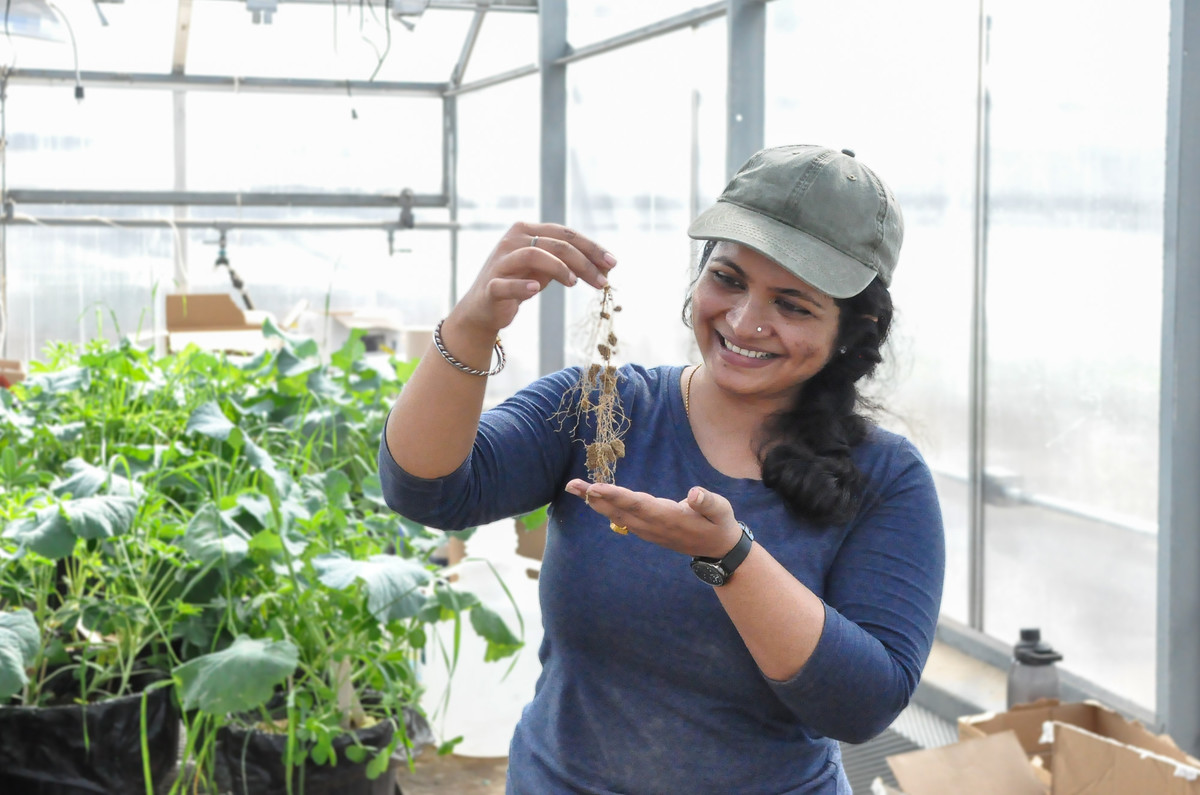
Poulamee Chakraborty, a postdoctoral researcher at Michigan State University, hopes she can make bioenergy crop systems more productive and sustainable by studying soil at the microscopic scale.
Since joining the Great Lakes Bioenergy Research Center in 2022, Chakraborty has authored papers on the legacy of agricultural management practices on switchgrass growth and soil carbon gains, the ways soil pores affect microbial oxygen consumption, and the soil carbon impact of plants engineered to accumulate readily-accessible carbohydrates.
Chakraborty is the recipient of the Great Lakes Bioenergy Research Center’s 2026 Jennifer L. Reed Bioenergy Science Award, an honor given to early-career scientists in recognition of their contributions to the center’s mission of advancing knowledge to enable production of sustainable fuels and chemicals from non-food plants.
GLBRC co-investigator Alexandra Kravchenko, a professor of plant, soil, and microbial sciences at MSU, says her mentee has “significantly strengthened GLBRC’s research portfolio” by advancing fundamental understanding of soil-plant-microbe interactions.
“Poulamee has made substantial and integrative contributions to the GLBRC through research that bridges soil physics, biogeochemistry, plant science, and microbial function to advance sustainable bioenergy cropping systems,” Kravchenko said.

A soil biophysicist, Chakraborty studies soil to understand how structures such as pores and mechanisms like drying and rainfall affect how nutrients like carbon and nitrogen move through plants and soil.
She uses technologies such as X-ray microscopy and tomography, microsensors, isotope labeling, and machine learning, to study intact soil samples, providing her a view of the undisturbed structures.
“(This is) where the microbes interact with the soil, or the plant roots are putting carbon into the soil, the microbes are taking up the carbon,” Chakraborty said. “So all those interactions take place in that very minute scale.”
The goal is to develop bioenergy crop systems that make more efficient use of nitrogen and carbon, producing bigger plants year after year with less need for fertilizer while keeping more carbon in the soil.
“If we understand more about it, we can use this knowledge later to improve the soil carbon accrual in the bioenergy systems,” Chakraborty said. “What are the micro-scale features that are making one bioenergy system (sequester) more carbon as compared to another … so that we can design a bioenergy system which would be more efficient in carbon and nitrogen cycling, and which will increase their production resiliency, and also would be good for the environment.”

Chakraborty said became interested in soil as an undergraduate studying biotechnology engineering in India. Her senior project involved collecting and analyzing soil samples from around the state. She was fascinated by the variability, even between samples collected within walking distance.
“This variability literally caught my interest to look more into the soil,” Chakraborty said. “I was not able to answer why they are so variable, so I wanted to find an answer to it.”
That led her to a master’s degree in soil science, where she discovered soil physics.
“Soil physics is something that is so fundamental,” she said. “Like physics, it governs everything. If you can understand physics, a lot of other things become clear to you.”
Chakraborty was working as a postdoctoral researcher at South Dakota State University when she saw a posting for a position in Kravchenko’s lab, which specializes in micro- to macro-scale biogeochemical processes involved in soil carbon and nitrogen cycling.
“I really wanted to join her lab,” Chakraborty said. “They know how to do it.”
Chakraborty is now working on a five-year field experiment to evaluate how neighboring plants affect switchgrass root systems. By supplying the plants with carbon dioxide made with carbon-13, a variant with one additional neutron, Chakraborty can use the isotope to trace how that carbon moves through the plant and into the soil.
The problem, Chakraborty explains, is that switchgrass does not add as much carbon to the soil as it could, in part because its roots tend to occupy the same pores from year to year rather than venturing out into new soil, where carbon gets digested by microbes and eventually bound to minerals.
“That's how the carbon gets stored in the soil for a long time,” Chakraborty said. “But switchgrass is kind of putting all those carbon (atoms) where they are very easily lost as carbon dioxide.”

Her hypothesis is that competition from neighboring plants stimulates the plants to extend their root structures. Legumes in particular may be good neighbors because they release chemicals to attract microbes that “fix” nitrogen, converting pairs of nitrogen atoms as they exist in the atmosphere into compounds that plants can use.
“So if we can find that (ideal) partner for switchgrass, we can then try to devise a bioenergy system growing switchgrass with that particular neighbor, which will stimulate its growth, put more carbon into the soil … increasing the carbon accrual and the nitrogen cycling,” Chakraborty said.
Chakraborty also serves as a co-investigator on the large-scale Molecular Observation Network (MONET) project with the Environmental Molecular Science Laboratory (EMSL), for which she led proposal development and coordinated soil sampling efforts.
In addition to her research – and raising her 18-month-old daughter, Saisha — Chakraborty has mentored graduate and undergraduate students in the lab and volunteers her time with Ecoteck Lab, a program that brings high school students from traditionally underrepresented into university labs.
“It is so fulfilling to work with those little minds,” she said. “They were so curious and they wanted to understand (science, technology, engineering, and math), but they were scared. I let them know STEM is not something to be scared of.”