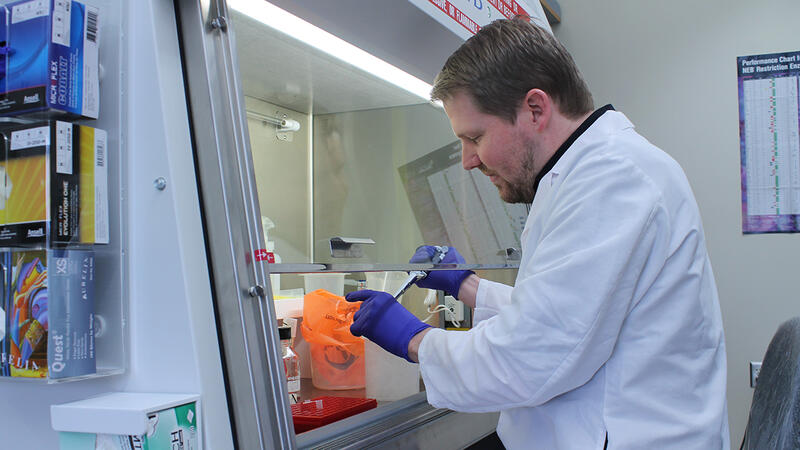
Scientists from the University of Wisconsin–Madison have developed a tool that researchers can use to selectively boost the activity of certain genes in bacteria, potentially unlocking discoveries in medicine and biotech.
This week, we sat down with Sreejata Bandopadhyay, a postdoctoral researcher in Ashley Shade’s lab at Michigan State University, and asked about her academic path, her interest in microbiome resilience, and the importance of her research for crop system management.
What happens when we get comfortable with uncertainty? Today, we talked to Audrey Gasch, professor of genetics at the University of Wisconsin-Madison and Great Lakes Bioenergy Research Center scientist, about all the factors that propelled her from an undergraduate studying biochemistry at UW-Madison to the leader of the Center for Genomic Science Innovation.
The U.S. Department of Energy (DOE) has announced $178 million for bioenergy research to advance sustainable technology breakthroughs that can improve public health, help address climate change, improve food and agricultural production, and create more resilient supply chains.
This week, Natalia De Leon, professor of Agronomy at the University of Wisconsin–Madison in the College of Agricultural & Life Sciences and Great Lakes Bioenergy Research Center researcher, talks about her decision-making process to find balance everyday as a scienti
We spoke with Megan Mader, an undergraduate student in Trey Sato's lab at the University of Wisconsin–Madison, to talk about what led to her interest in climate change, her research on modifying yeast to sustainably produce biofuels, and the value of collaboration in research.
Scientists from the Great Lakes Bioenergy Research Center and the Joint BioEnergy Institute produced a new type of poplar that incorporates a potentially valuable coproduct into its lignin and is easier to deconstruct
What happens when the thing you thought you wanted turns out to be different than what you expected? This week, Great Lakes Bioenergy Research Center Research Coordinator Adrianna Trusiak talks about the pressures of grad school and the tough choices she made to shift her career path.
A new process developed by scientists at the Great Lakes Bioenergy Research Center enables greater production of squalene, a terpene with an array of uses in the biotechnology industry and as an energy-dense biofuel. Researchers increased plant production of the chemical by redirecting production to lipid droplets scaffolded to plastids in the cell.
The Great Lakes Bioenergy Research Center's outreach team joined groups from across UW–Madison for a Saturday of science exploration at the Kujichagulia Center for Self-Determination's Juneteenth celebration on June 18 at Penn Park in Madison. Attendees were invited to explore science at nearly a dozen UW Science Alliance hands-on educational stations, chat with scientists, and more.
What does it mean to foster an environment that truly feels welcoming? For Yiying Xiong, associate director of the Great Lakes Bioenergy Research Center, it all comes down to treating a team of coworkers like they are part of a family. Xiong spoke with us about her experiences nurturing these families in the hydropower industry and now academic research.