
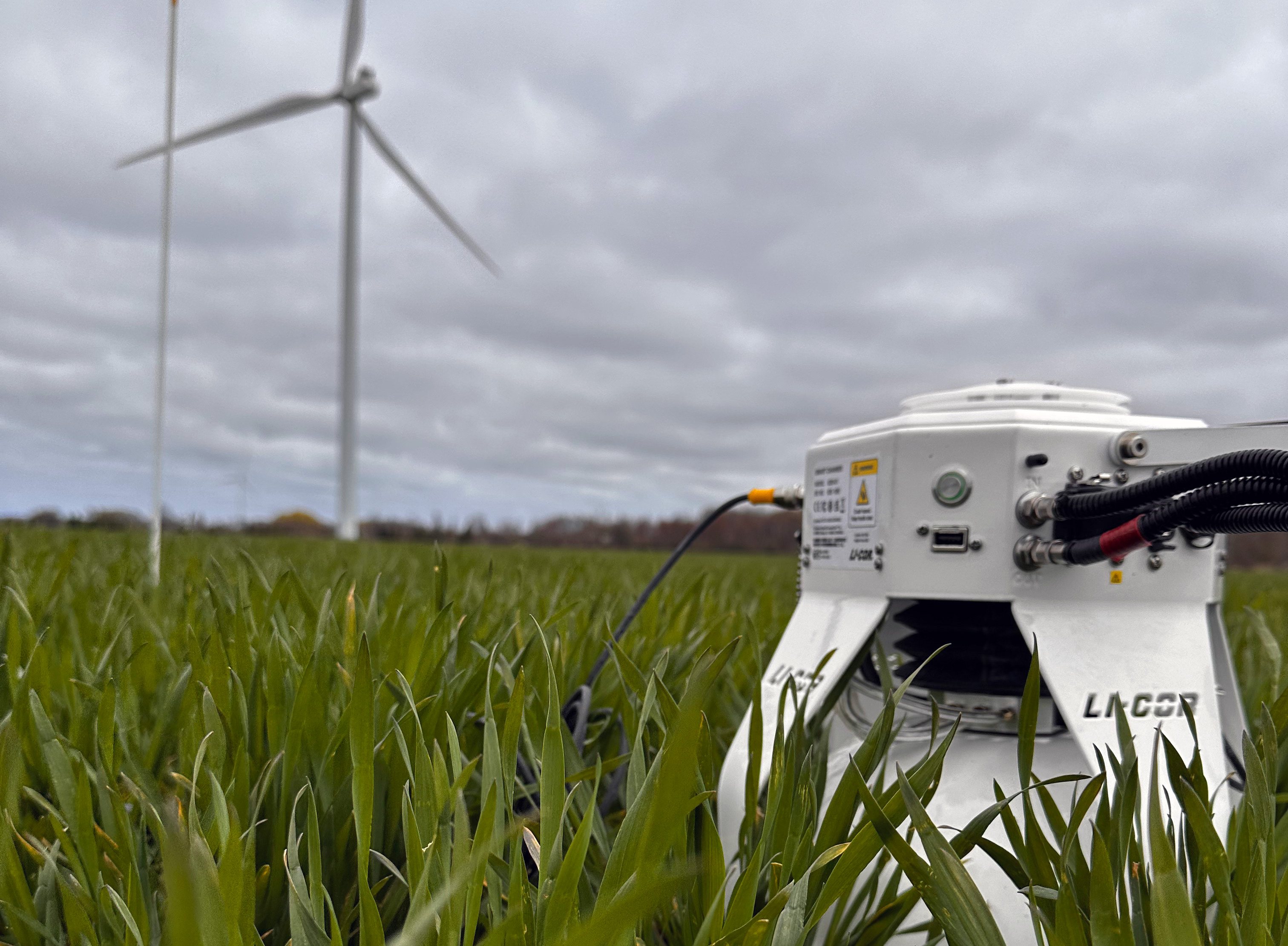
Great Lakes Bioenergy Research Center scientists at Michigan State University have developed a groundbreaking machine learning system capable of predicting nitrous oxide emissions from U.S. croplands with unprecedented accuracy, a finding with valuable implications for national greenhouse gas accounting and mitigation.
The study was published in the journal Proceedings of the U.S. National Academy of Sciences.

Nitrous oxide is a greenhouse gas emitted in agricultural operations primarily through the use of nitrogen fertilizers. Accurately predicting emissions has eluded scientists due to the complex interplay of weather, soil conditions and crop management practices that influence the microbes responsible for producing the gas.
The new research changes that.
Led by former MSU graduate student Prateek Sharma and Hannah Distinguished Professor Bruno Basso in MSU’s Department of Earth and Environmental Sciences and the W.K. Kellogg Biological Station (KBS), the team developed a hybrid modeling system that combines machine learning and ecosystem models to capture daily nitrous oxide emissions.

G. Philip Robertson, University Distinguished Professor at KBS and in the Department of Plant, Soil and Microbial Sciences, co-led the research. Professor Michael Murillo in the Department of Computational Mathematics, Science and Engineering also contributed.
The modeling system leveraged more than 12,000 nitrous oxide measurements collected across 17 sites in the U.S. Midwest and Great Plains, spanning six cropping systems and 35 management practices — one of the most comprehensive datasets of its kind. Whereas conventional single-model approaches for estimating nitrous oxide emissions struggle to achieve 20% prediction accuracy, Basso said accuracy for the new ensemble system exceeded 80%.
"One of the limiting factors of current predictive models is that they rely on outdated national greenhouse gas emission inventories and often need to be calibrated to a specific site," said Basso, whose work is supported in part by MSU AgBioResearch. "With this effort, we’ve moved past these limitations to provide management-specific predictions for crucial combinations of cropping systems, soils, management practices and weather conditions. We're hopeful this approach can lead to field-specific emission mitigation strategies, as well as much-needed updates to estimates of greenhouse gas emissions from agriculture."
This story was originally published by MSU's AgBioResearch division.