
News
Sustainable Biomass Conversion
Sparking Curiosity: Sydney Bradley uses art to make science more accessible
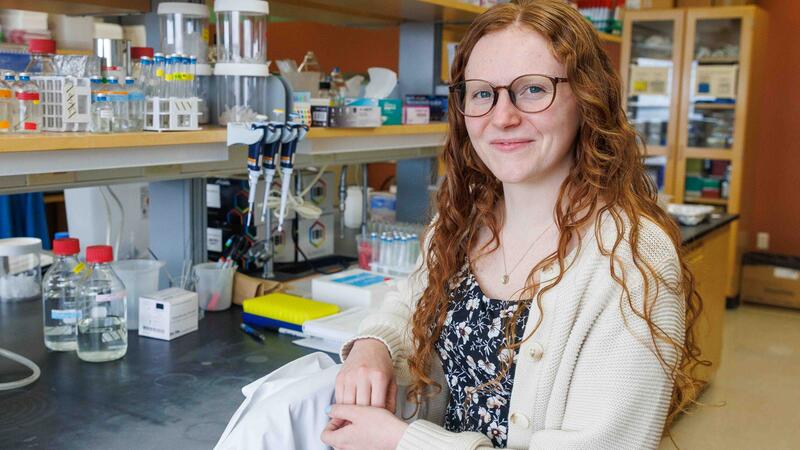
As a graduate researcher at the University of Wisconsin–Madison, Sydney Bradley studies microbiology in pursuit of better biofuels. But she’s not just interested in publishing her findings in scientific journals.
Diterpenoid alkaloids have a wide range of uses, from natural pesticides to treatments for cancer, malaria, inflammation, pain, and nausea. But their complex structures make them extremely difficult to create in the lab, meaning natural production, or biosynthesis, is the most promising alternative. These findings mark the first established pathway for a diterpenoid alkaloid, enabling biosynthetic production and serving as a basis for discoveries that could lead to production of more complex products.
Samuel Chagas is a postdoctoral researcher in Rebecca Smith’s lab, where he studies the composition of plant cell walls in sorghum and corn to develop crops that are easier to digest, whether for biofuel or animal feed.
Sarada Sripada is a postdoctoral researcher working in the Sener lab. She studies reductive catalytic fractionation (RCF) with the goal of deconstructing lignin, the woody part of plant cells, into smaller molecules that microbes can convert into valuable products such as PDC, a chemical that can be used to make bioplastics.
Great Lakes Bioenergy Research Center co-investigator Troy Runge, an associate dean and professor of biological systems engineering, has been selected to serve as interim dean of the College of Agricultural and Life Sciences.
As a microbiologist, Trey Sato occasionally witnesses a genetic interaction, a rare phenomenon that occurs when the combination of two traits results in an impact greater than the sum of its individual parts. He sees a parallel in his career.
Since joining GLBRC in 2022, Dae Kwan Ko has helped develop computational frameworks and data sets that support other GLBRC scientists in the quest for genes that contribute to more resilient and bountiful bioenergy crops.
Carolina (Caro) Córdova is an assistant professor of agronomy and horticulture at the University of Nebraska–Lincoln and a statewide soil health specialist with UNL Extension. With a PhD in soil science from Iowa State University, Córdova was a postdoctoral researcher and field research coordinator with GLBRC from 2018 to 2022.
Now a senior research manager for the animal genetics firm Genus, Brian Burger joined GLBRC in 2009 after earning a PhD in biology from the University of California-San Diego. Burger spent about 8 years at the center, first as a postdoctoral researcher and later as a staff scientist.
As a postdoctoral researcher in Phil Robertson’s lab at Michigan State University, Ilya Gelfand's research led to a 2013 Nature paper highlighting the potential for growing cellulosic bioenergy crops on marginal farmland. Gelfand is now an associate professor at Ben-Gurion University of the Negev in Israel, where he studies biogeochemistry and ecosystem ecology.
Since joining the Great Lakes Bioenergy Research Center in 2022, Poulamee Chakraborty has authored papers on the legacy of agricultural management practices on switchgrass growth and soil carbon gains, the ways soil pores affect microbial oxygen consumption, and the soil carbon impact of plants engineered to accumulate readily-accessible carbohydrates.


