
News
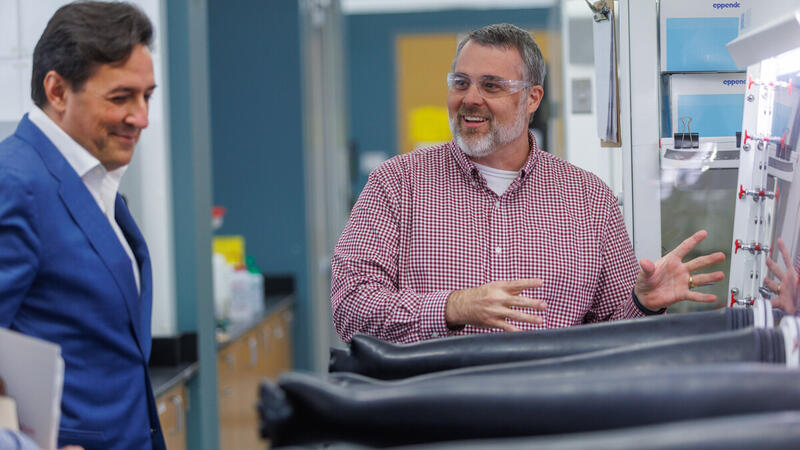
UW–Madison research tour showcases BioAutomation Lab
DOE Under Secretary for Science Darío Gil met with researchers from across campus and local tech industries to learn about UW–Madison’s research enterprise and alignment with DOE priorities. Discussions focused on opportunities to strengthen public-private partnerships, accelerate technology commercialization, expand workforce development and better position Wisconsin as a well-coordinated innovation ecosystem.
Now a senior research manager for the animal genetics firm Genus, Brian Burger joined GLBRC in 2009 after earning a PhD in biology from the University of California-San Diego. Burger spent about 8 years at the center, first as a postdoctoral researcher and later as a staff scientist.
As a postdoctoral researcher in Phil Robertson’s lab at Michigan State University, Ilya Gelfand's research led to a 2013 Nature paper highlighting the potential for growing cellulosic bioenergy crops on marginal farmland. Gelfand is now an associate professor at Ben-Gurion University of the Negev in Israel, where he studies biogeochemistry and ecosystem ecology.
Since joining the Great Lakes Bioenergy Research Center in 2022, Poulamee Chakraborty has authored papers on the legacy of agricultural management practices on switchgrass growth and soil carbon gains, the ways soil pores affect microbial oxygen consumption, and the soil carbon impact of plants engineered to accumulate readily-accessible carbohydrates.
Great Lakes Bioenergy Research Center co-investigator John Ralph has been elected to the National Academy of Sciences, one of the highest honors a scientist can receive, in recognition of his research accomplishments.
GLBRC investigator Holly Gibbs is among five University of Wisconsin–Madison faculty members elected to the American Academy of Arts & Sciences. As a geographer, she studies how and why people use land around the world and what these changes mean for the future of our planet.
Rebecca Smith uses genetic tools to develop plants that can be digested more easily. The outcomes could be greater efficiency for biofuel production and lower methane emissions from dairy cows.
Fong Liew is a graduate student in Brian Fox’s biochemistry lab, where she works in collaboration with Tim Donohue’s bacteriology lab on converting lignin, one of the main components of plant cell walls, into valuable industrial chemicals.
GLBRC researcher Brandon Kristy from Michigan State University has won a prestigious Department of Energy fellowship that will allow him to study mutually-beneficial relationships between plants and microbes at the Lawrence Livermore National Laboratory.
Researchers tested a bioreactor system to process aromatics from poplar trees with a modified strain of Novosphingobium aromaticivorans that releases a chemical known as PDC while accumulating two other products inside the cells: a natural pigment and a vitamin-like substance found in most human cells. PDC can be used to make plastics, while the other products are used in nutritional supplements, cosmetics, and animal feed.
Building on previous work using RCF to deconstruct poplar, Great Lakes Bioenergy Research scientists evaluated six solvents in pure form and in varying mixtures with water and used the results to develop a computational model for solvent selection. The results showed a 50/50 mixture of methanol and water performed the best because it reduces reactor pressure and doesn't interfere with the microbes and lowers the break-even cost of the product by 24%.


