
System approach innovations improve understanding of plant resilience
Understanding how plants respond to stress is key to breeding crops to withstand increasingly harsh and variable conditions.
Dae Kwan Ko is willing to invest the time to learn cutting-edge technologies that will help unlock this knowledge.
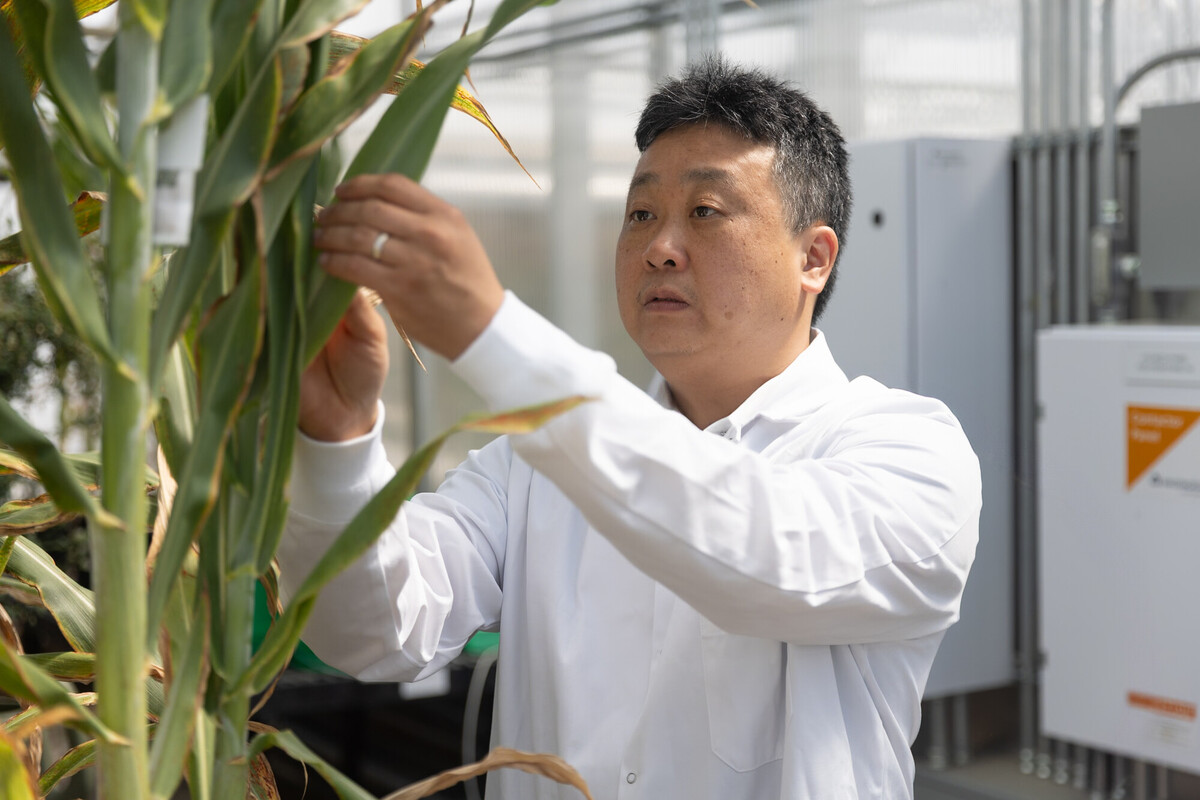
A fixed-term research assistant professor in the Department of Plant Biology at Michigan State University, Ko works in the lab of GLBRC co-investigator Federica Brandizzi, where he uses systems-level approaches to decipher the complex interactions between genes and proteins involved in building plant cell walls.
Since joining GLBRC in 2022, he has helped develop computational frameworks and data sets that support other GLBRC scientists in the quest for genes that contribute to more resilient and bountiful bioenergy crops.

“Dr. Ko is at the forefront of bioinformatics and functional genomics in crop resilience biology,” Brandizzi said. “(He) has demonstrated exceptional dedication, creativity, and scientific rigor. I am enthusiastic about both his contributions to date and his strong potential to continue advancing as an independent researcher in plant stress resilience."
In recognition of his innovative approach and high-impact research, Ko has been awarded the 2026 Yaoping Zhang Bioenergy Research Award.
Given to GLBRC researchers for outstanding contributions to the center’s mission of developing sustainable biofuels, the award is named in honor of Yaoping Zhang, a senior scientist who led the Experimental Fermentation Lab from 2011 until his death in 2024 and whose collaboration supported dozens of studies.
Ko said he likes being part of an interdisciplinary center where “everything is connected.”
“My work is more systems biology,” he said. “I look at molecular interactions, how genes and proteins interact with each other. And then step back and look at the big picture.”
Brandizzi said Ko’s expertise in experimental biology and computation is a “rare and powerful combination that has enabled him to tackle complex and timely questions in gene regulation.”
Ko made a significant contribution in 2025 with a novel gene-discovery pipeline known as NEEDLE that addresses one of the central challenges in bioenergy crop research: identifying key regulatory genes and pathways in “non-model” plants where knowledge of gene functions remains limited.
NEEDLE enabled the prediction of upstream regulators of a gene involved in the production of mixed-linkage glucan, a chain of sugar molecules that are easy for microbes to ferment into biofuels and other products.

Ko’s analyses of gene activity in sorghum have provided foundational insights into how stress changes gene expression across developmental stages.
Brandizzi said together these contributions provide computational frameworks, datasets, and validated gene targets that directly support the center’s mission to advance sustainable bioenergy crop improvement.
Ko is now developing a single-cell sequencing pipeline to study stress response in sorghum, a promising bioenergy crop with scarce analytical resources for such work.
“Ko has laid the foundation for generating high-resolution datasets that will enable entirely new insights into sorghum stress biology,” Brandizzi said. “I expect this project will produce the first comprehensive stress response atlas at single-cell resolution in sorghum, representing a transformative resource for GLBRC and the broader plant science community.”
Ko hopes his insights into sorghum stress resilience can be used to develop climate resistant crops.
“That’s my big picture,” he said, “And I don’t know how I can do that at this moment, but one thing I try to do is use state of the art technologies. The science is going really fast.”