
Manure can be a source of plant-based chemicals
The Science
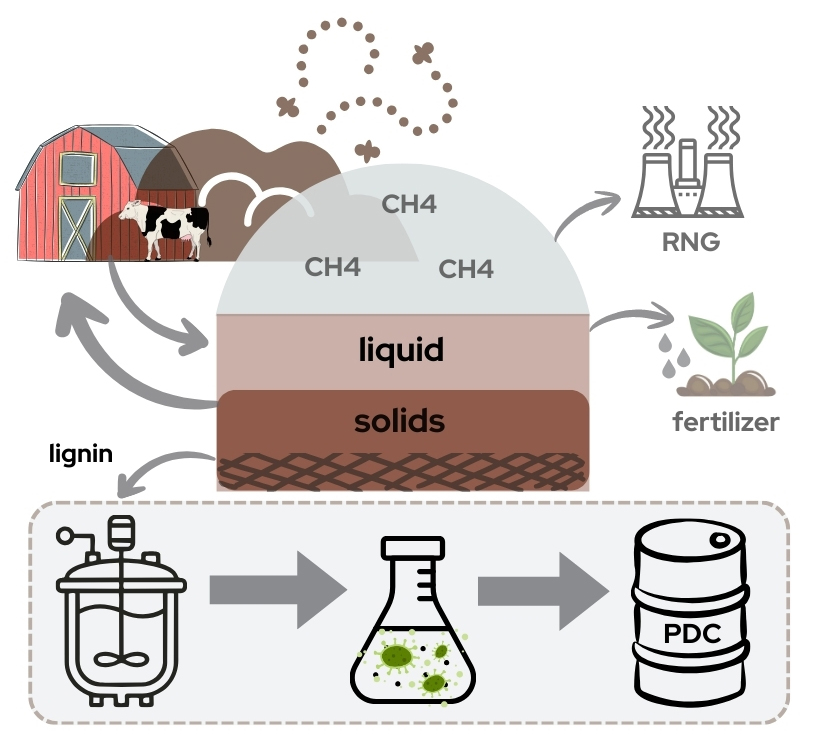
Cattle, raised for beef and dairy production, generate billions of tons of manure. When livestock farming is concentrated in certain areas, this manure contains more nutrients than nearby farmland requires, and transporting it long distances is costly and inefficient. Anaerobic digesters can capture value from the organic waste in the form of biogas. The leftovers, known as digestate, contain liquids that can be used as fertilizer and solids, which require additional management and disposal. The solids are mainly plant fibers that cows couldn't digest, which are slow to decompose but contain potentially valuable compounds. Researchers with the Great Lakes Bioenergy Research Center hypothesized that lignin, a part of the plant cell wall that provides structure, in the manure fibers could be a source of ring-shaped molecules known as aromatics. GLBRC research has focused on ways to extract aromatics from purpose-grown energy crops such as grasses and trees and using engineered microbes to convert those aromatic molecules into chemicals used to make plastics. For this study, they ran experiments to see if that technology could work on plant fibers that survived the digestion processes.
Researchers used analytic techniques to determine that lignin is the major component of the post-digestion fibers, accounting for about 30% by weight, which is a concentrated source of lignin when compared to the ratio in raw biomass. Next they evaluated two processes designed to break down lignin into streams of aromatic compounds called phenols that microbes can digest. An alkaline-based treatment yielded 5.6 grams of phenolic compounds per kilogram of dry fiber, which is about 38% lower than typical yields from corn stover or sorghum. The second method, which uses solvents under heat and pressure with a catalyst to speed up reactions, produced a higher overall yield, but the mixture was primarily compounds that cannot be converted to the target chemical. Finally, researchers used an engineered microbe called Novosphingobium aromaticivorans to convert the phenolic compounds into a compound known as PDC, which can be used to make bioplastics. The PDC titer, while modest in this demonstration compared to optimized processes using plant biomass, shows that aromatics from anaerobically digested manure fibers can be used to produce valuable products.
The Impact
The United States, the world's largest producer of beef and third-largest producer of dairy, produces 43 million metric tons of manure, representing a waste management challenge as well as a potential renewable, domestic source of chemicals used to produce plastics, nutritional supplements, and medicines. This study demonstrates that post-anaerobic digestion manure fibers can be converted into valuable products.
Summary
Anaerobic digestion of manure produces biogas, nutrient-rich liquids, and solid residue that requires additional management and disposal. Researchers hypothesized that residual lignin in post-anaerobic digestion manure fibers represents a substantial source of aromatic compounds and that methods developed for valorization of energy crops could be applied to extract aromatics for microbial conversion to dicarboxylic acids for potential use as platform chemicals for production of bio-based polymers.
Researchers performed compositional analytics and nuclear magnetic resonance to determine lignin content and aromatic composition of post-anaerobic digestion manure fibers and evaluated two processes for producing aromatic-rich streams from the fibers: a sequence of alkaline pretreatment, acid digestion, and liquid-liquid extraction to generate an extracted alkaline pretreatment liquor (eAPL); and reductive catalytic fractionation (RCF) with methanol and a Pd/C catalyst. Results showed lignin represents ~30% of the manure fiber by dry weight. Alkaline pretreatment yielded 5.6 g aromatics/kg manure fibers. Bioconversion of eAPL by an engineered strain of N. aromaticivorans in a batch-fed reactor produced a yield of ~1 mol PDC/mol measured aromatics at a rate of 0.2 g PDC/L-h and a titer of 2.6 g PDC/L. RCF yielded 14 g aromatics/kg manure fibers, preferentially producing ethyl and propyl phenolics that, with the engineered N. aromaticivorans strain used, could not be transformed to a dicarboxylic acid product.