
Hybrid reactor system optimizes production by ‘multitasking’ microbes
The Science
Plant fibers are a potential renewable source of fuels and chemicals traditionally derived from petroleum. Plant sugars can be fermented into alcohols used as drop-in fuel or processed into jet fuel, while other parts can be transformed into chemicals used to make plastics, medicines, and other products.
Engineered microbes can produce these chemicals from aromatic compounds, ring-shaped molecules found in part of the plant cell wall called lignin. But making these chemicals results in a lot of bacterial cells that have to be disposed of. So scientists with the Great Lakes Bioenergy Research Center developed a “multitasking” microbe that can generate different products internally and externally, turning the waste cells into another source of revenue. The next challenge was applying engineering principles to improve productivity in a bioreactor.
Here researchers tested a bioreactor system to process aromatics from poplar trees with a modified strain of Novosphingobium aromaticivorans that releases a chemical known as PDC while accumulating two other products inside the cells: a natural pigment and a vitamin-like substance found in most human cells. PDC can be used to make plastics, while the other products are used in nutritional supplements, cosmetics, and animal feed.
The experiments showed operating the reactor in a continuous flow mode maximized PDC production at the cost of the internal products. But loading the plant material a little bit at a time resulted in stable production of both product streams.
The Impact
Non-food plants — including purpose-grown energy crops and agricultural waste — are a potential source of renewable fuels and chemicals that could support a domestic bioeconomy. To be economically viable, lignocellulosic biorefineries must derive value from all major parts of the plant, requiring novel strategies to make use of aromatic compounds stored in lignin. This study establishes bioreactor operating conditions for stable production of internal and external products, potentially adding value to large amounts of byproduct.
Summary
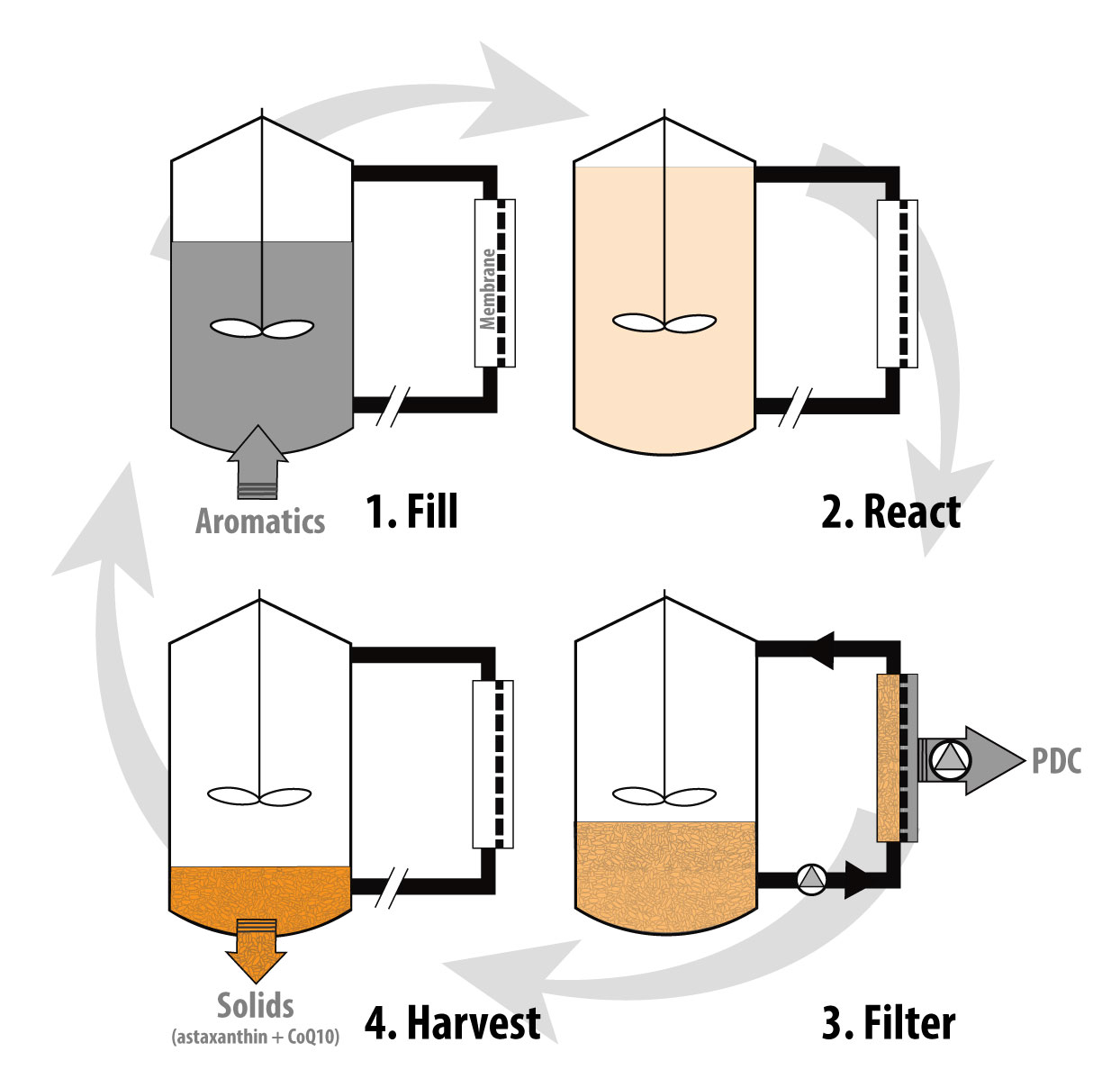
Building on previous efforts to engineer N. aromaticivorans for extracellular production of 2-pyrone-4,6-dicarboxylic acid (PDC) and intracellular accumulation of astaxanthin and coenzyme Q10 (CoQ10), Great Lakes Bioenergy Research Center scientists investigated strategies to achieve high productivity of both products in a previously described membrane bioreactor (MBR) system.
Initial experiments showed that continuous flow operation maximized extracellular production but had a negative effect on intracellular product accumulation. They next evaluated a sequencing batch reactor (SBR) process with a synthetic media containing p-hydroxybenzoic acid (pHBA) as the aromatic compound, increasing pHBA concentrations through eight cycles. PDC yield increased in cycles two to six but decreased in cycles seven and eight. CoQ10 accumulation was stable across all eight cycles, but astaxanthin accumulation fell by 50% in the final two cycles. Together the results suggest cellular stress under high pHBA concentrations affects production.
Adding smaller volumes of media intermittently to keep pHBA media concentration below 20 mM resulted in a four-fold increase in PDC production with no loss of intracellular product accumulation. Using concentrated poplar alkaline pretreatment liquors, the SBR-MBR system with step-feed operation achieved production rates of 1.14 g PDC/L-hr, 0.043 mg astaxanthin/L-hr, and 0.64 mg CoQ10/L-hr.
Compared to the previous study (Hall et al.), optimizing the bioreactor performance and using concentrated APL resulted in a 15-fold increase in PDC titer, a 4-fold decrease in astaxanthin yield, and a 3-fold increase in CoQ10 yield. While astaxanthin yield decreased, the production rate increased 43-fold because of the high-density cultures created. The authors concluded that increasing astaxanthin yields in N. aromaticivorans may require additional engineering to increase carbon flux through carotenoid pathways.