
Advancing science through service: GLBRC scientist Trey Sato honored for collaborative leadership
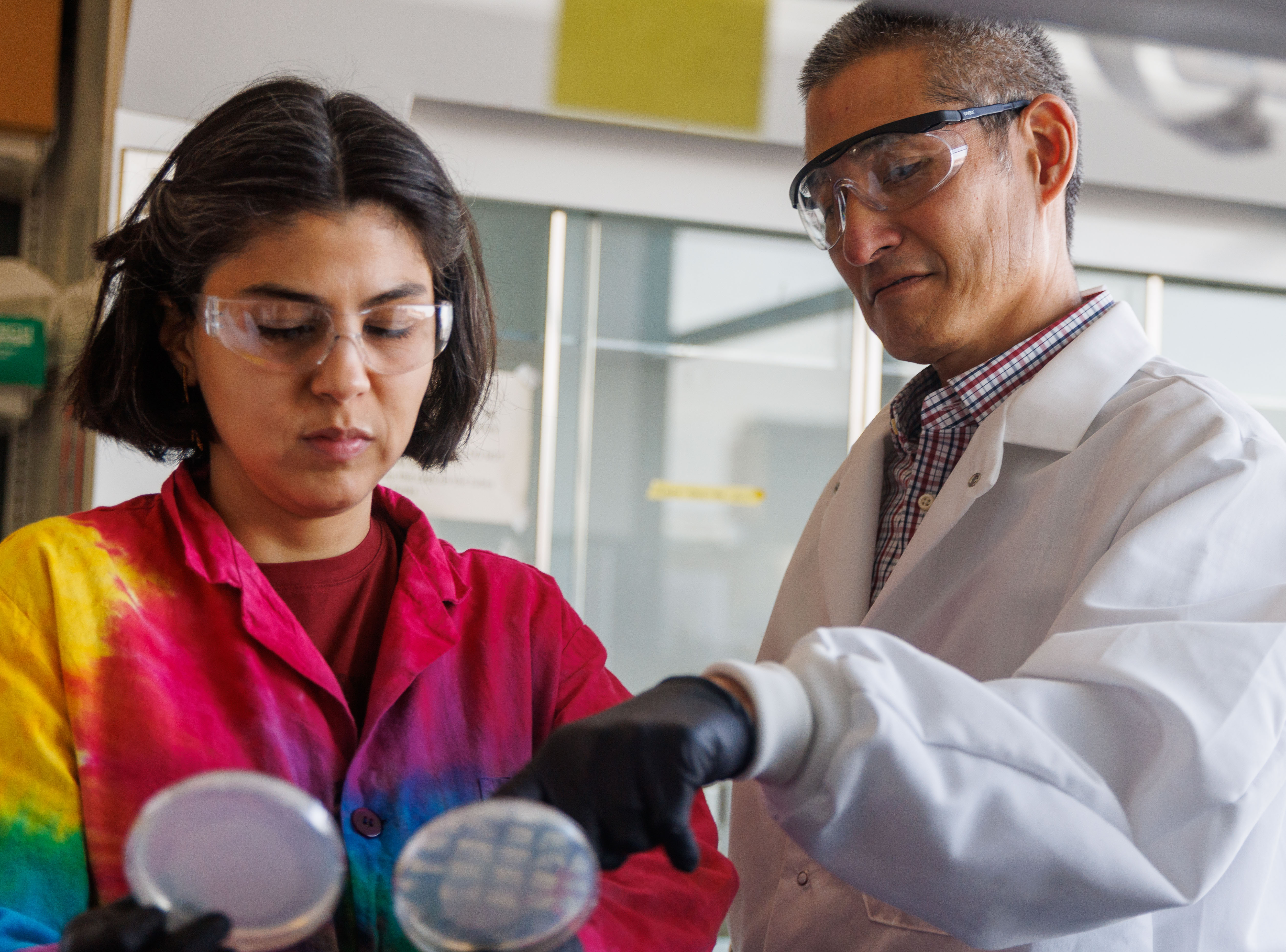
As a microbiologist, Trey Sato occasionally witnesses a genetic interaction, a rare phenomenon that occurs when the combination of two traits results in an impact greater than the sum of its individual parts.
He sees a parallel in his career.
“All the impacts I’ve made are the result of synergistic interactions with my colleagues,” Sato said.
After joining the Great Lakes Bioenergy Research Center as a staff scientist in 2008, Sato realized he didn’t have the resources to churn out papers like a faculty member with a stable of graduate students.
Instead he collaborated with other co-investigators.
“I sort of see my role as helping to enable others … to get more out of their research,” Sato said.

Sato has coauthored more than 75 peer-reviewed papers in his nearly two decades with the center, one of four Department of Energy research centers focused on doing basic science to support development of fuels and chemicals from non-food plants. The center has now honored him with the 2026 Service and Impact Award in recognition of his nearly two decades of service and collaborative leadership.
“Trey is a key part in enabling a collaborative and supportive culture at GLBRC,” said Amy Enright Steinberger, a postdoctoral researcher in Jason Peters’ genetics lab at UW–Madison. “He is skilled at managing many cross-disciplinary projects and accomplishes all of this with an even-keeled and positive demeanor and great respect for his colleagues.”
Sato earned a PhD from the University of California at San Diego for his work on membrane fusion in Saccharomyces cerevisiae. He then spent seven years working on high-throughput screening for investigations of the mammalian circadian clock before joining GLBRC in 2008, shortly after the center’s launch.
Sato said he was happy to return his research focus to yeast.
“Harvesting yeast is much more fun than harvesting mice, I suppose,” Sato said. “The genetic tools to manipulate yeast are really mature… so it's fun to be able to come up with hypotheses that you can test within weeks… You could probably do it in a shorter amount of time with bacteria, but they don't smell as bad as bacteria.”
Sato said he’s proud to have collaborated with early-career faculty members who have gone on to earn tenure, including GLBRC co-investigators Peters, an associate professor of medical genetics and Audrey Gasch, a professor of genetics and director of the Center for Genomic Science Innovation.
Peters likens Sato to the organization’s sympathetic nervous system, which regulates vital functions like breathing, heart rate, and digestion.
“Trey is making sure that the budgets are in line, that we have objectives and deliverables we are actually supposed to accomplish, and reminding us that we have no future without AI competence,” Peters said. “He’s also a fabulous scientist.”

GLBRC co-investigator Berkeley Walker, an associate professor of plant biology at Michigan State University, said Sato’s lab is “a critical hub” for the biomass-to-biofuel testing pipeline.
“Trey is the type of collaborator you can only dream about,” Walker said. “Someone who selflessly works to ensure the success of the project while critically evaluating the implication of the results.”
Sato has established external collaborations with other Department of Energy Bioenergy Research Centers as the GLBRC’s representative for the feedstock-to-fuels shared resource objective.
For example, Sato worked with the Center for Advanced Bioenergy and Bioproducts Innovation and the Joint BioEnergy Institute to evaluate the effects of various pretreatment methods on fermentation of engineered sugarcane bagasse.
In addition to his collaborative leadership, the award recognizes Sato for taking on additional roles, including stepping in to run the Experimental Fermentation Lab after the death of his colleague Yaoping Zhang in 2024.
“He played an essential role in the leadership transition for the EFL, which provides key services to many groups at GLBRC,” Steinberger said.
Sato is also praised for his mentorship.
“Trey Sato is an incredible scientist, collaborator, and boss, embodying the values of the GLBRC on a daily basis,” said Morgan Davies, a research specialist in Sato’s lab who nominated him for the award.
“When I started in the Sato Lab, I was afraid that my lack of knowledge on genetic concepts would inhibit my ability to succeed in this role,” said former research intern Molly Hardwick. “I learned more from him in a couple of months than in my semester-long genetics course as an undergraduate student.”