
Summer Undergraduate Research Program at UW–Madison
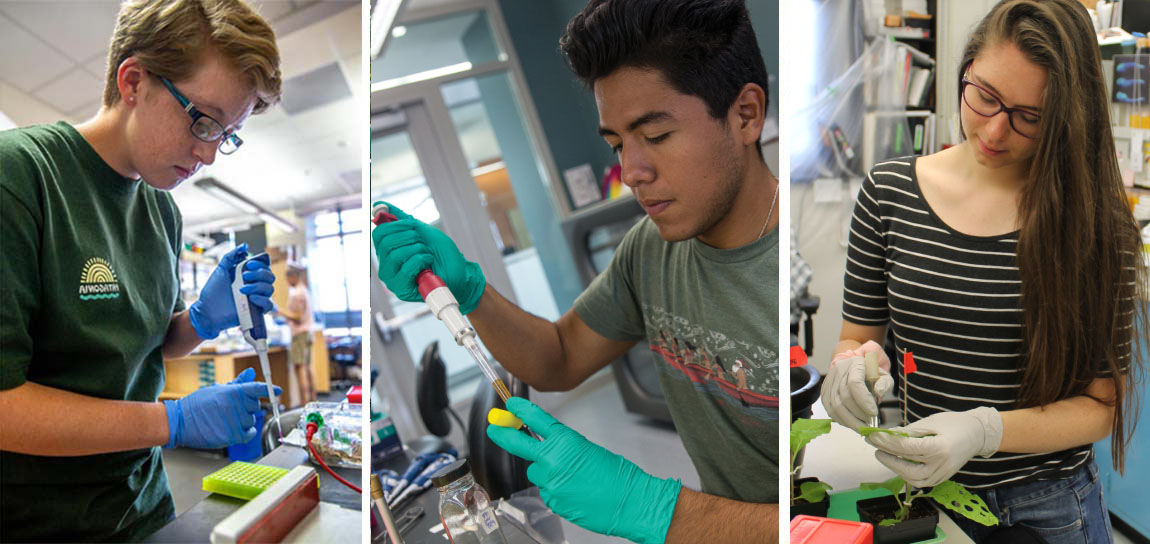
Each summer, GLBRC hosts a group of undergraduate students to participate in the Research Experience for Undergraduates (REU) program, designed to immerse students in research. Mentors guide students throughout the research process, from designing their experiments to presenting their findings on a poster. Students participate in professional development activities, build references for graduate school, and explore research as a potential career.
GLBRC's REU program is run in partnership with the University of Wisconsin–Madison's Department of Chemistry, Department of Chemical and Biological Engineering, and the Wisconsin Institute for Science Education and Community Engagement (WISCIENCE). Read the descriptions below to learn more about the program topic areas.
Program Topic Areas
Biological Interactions Summer Research Program
The Biological Interactions Summer Research Program gives undergraduate students a full-time, mentored research experience at UW–Madison. Students spend 10 weeks on campus working in a bioscience research lab, building research skills, and learning more about graduate school and research careers in biology.
The program is designed for students who are interested in biological science research and may not otherwise have access to research opportunities. Participants complete an independent research project with guidance from trained mentors and take part in weekly professional development activities with a supportive cohort of peers.
For more information, eligibility requirements, and application instructions, visit the official program page.
REU in Chemical and Materials Engineering for Future Manufacturing
The University of Wisconsin–Madison Departments of Chemistry and Chemical and Biological Engineering, through support from the National Science Foundation, host an annual Research Experience for Undergraduates (REU) program focused on developing new technologies for future manufacturing. Students participating in this program conduct research on the development of new materials and new processes for future catalysis, electrochemistry, circular manufacturing of plastics, novel pharmaceuticals, semiconductors, microelectronics and metabolic engineering of biofuels.
For more information, eligibility requirements, and application instructions, visit the official program page.