
Machine learning helps pick the best solvents for the job
The Science
Solvents, such as water or paint thinner, are solutions that dissolve another substance. When designing chemical processes, the choice of solvent affects factors such as how well the target substance, or solute, dissolves; the energy required; and the cost. Some solvents work better in certain cases, such as separating chemicals that are very similar. There are also environmental factors: Solvents that contain halogen atoms, such as chlorine or fluorine, are effective but also toxic. The vast number of solvents, which can be used in different mixtures, makes it impractical to choose a solvent through trial and error.
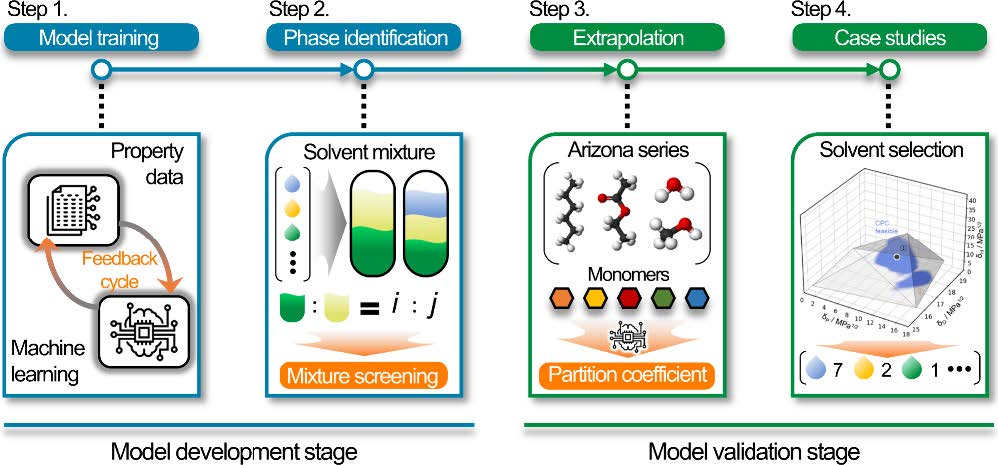
Researchers with the Great Lakes Bioenergy Research Center previously combined physical experiments with machine learning, a type of artificial intelligence, to streamline the process. That experimental design approach allowed scientists to narrow the field of most promising solvents to test, but the model only worked with predefined sets of solvents and products. In order to expand the field of potential solvents and products, GLBRC researchers have now trained a machine learning model to predict which solvent mixtures will best dissolve a compound based on their physical and chemical properties. They combined those predictions with other factors, such as solvent sustainability and how the solvents react under different conditions. They demonstrated the framework in two case studies: finding sustainable alternatives for halogenated solvents and identifying solvent mixtures that can be used to separate similar compounds found in deconstructed plant fibers in order to convert them into valuable chemicals.
The Impact
Solvent selection is a critical step in the design of any chemical process, affecting sustainability and profitability, but the nearly infinite combination of solvent mixtures and solutes makes the selection challenging. This computational framework can accelerate the discovery of greener solvent mixtures and identify the best solvents to separate similar products in biomass, advancing biobased manufacturing.
Summary
GLBRC researchers developed a machine learning model to screen solvent mixtures for separation performance by representing solvent components using Hansen solubility parameters (HSP), a set of numbers that help predict whether one substance will dissolve in another. They trained the model to predict a solute's partition coefficient, or how it tends to divide itself between two solvents. By weighting HSPs by component volume fractions, the model can represent mixtures with varying compositions. Solutes are represented by physiochemical descriptors.
Researchers trained the model using two datasets of experimentally measured partition coefficient values for lignin-derived compounds in chemically diverse solvent mixtures. Testing revealed the model was more accurate than the previous experimental design approach, and the framework enables extrapolation to solutes and solvents not encountered during model training. Researchers used the model to evaluate solvent mixtures with four or more components to separate lignin-derived aromatic products with similar physiochemical properties and identified solvent mixtures predicted to achieve similar separation performance as known mixtures containing halogenated solvents. They also identified sets of solvents suitable for use with centrifugal partition chromatography, an emerging liquid-liquid separation method.