
Grad Student Spotlight: Bailey Marshall
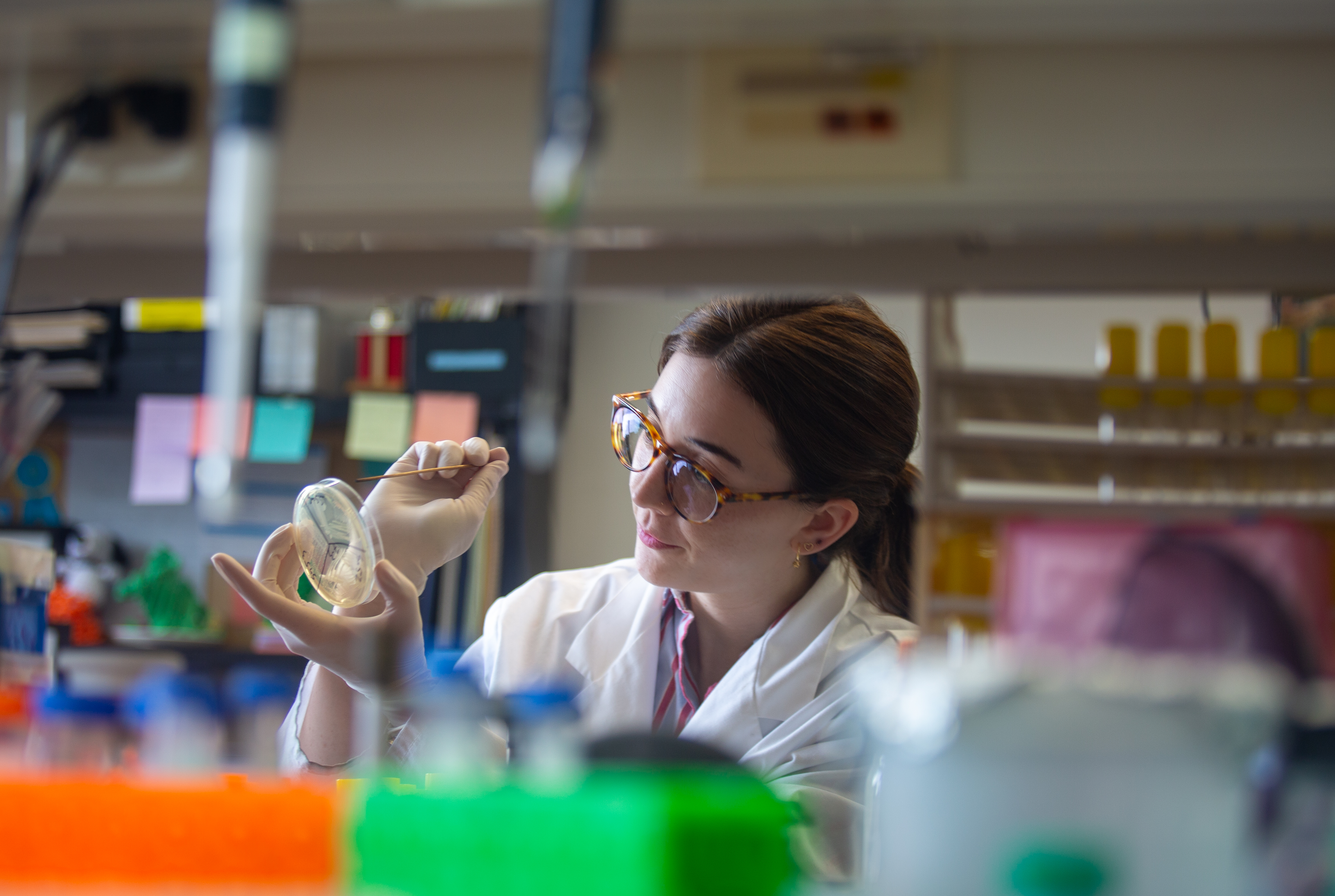
Bailey Marshall, a PhD candidate in cellular and molecular biology, works in Robert Landick’s lab, where she studies genetic engineering of bacteria for better biofuel production.
Tell me about your research.
The problem that we're addressing is this issue where we don't have energy in the right places. We get all the energy we need from the sun, but we can't necessarily apply it the way we would like to across society. Bacteria allow us to take energy from the sun that the plants capture and convert it into biofuels or bioproducts. My research is in metabolic engineering of Zymomonas mobilis. Our goal here is to take the microbe as it is in nature and engineer it into something useful for biotechnology: making bacteria that can solve this bioenergy problem. I think of my research under the synthetic biology umbrella.

What do your day-to-day responsibilities look like?
It's a lot of small volumes of clear liquids. I work up an experiment where I want to test a question at the genetic scale: If I add this gene, what will happen? Or my project specifically was: if I added this gene to this level, what will happen? I manipulate gene levels to try and find a Goldilocks scenario where they're expressed at the ideal ratios.
Once we have a genetic design in a computer, we generate this DNA that we put into our bacteria. I grow up my strain – I think I’ve made 150 strains since I started – then I take my samples and test how the metabolic engineering affected the yield of a specific biofuel that we're trying to optimize the production of.
I really can't help but feel like E. coli and yeast are my best friends. They're not so different from cats and dogs, where they're highly domesticated and really, really useful.
What motivated you to become interested in this field?
I love microbes, and I love DNA, and I think they're both so fun. I've always loved working with them since my junior year of high school, when I was introduced to the central dogma. I was hooked. In my first job, I ran a DNA sequencer, and I just loved how much data it produced. It was incredible. There were so many answers in the DNA sequencing data. I just wanted more. That’s what drove me to graduate school.

What is one thing that you wish more people understood about your field?
I wish that people understood how closely connected and related we are to microbes. Not only are we hosts to so many microbes that aid us in our ability to live, but we are covered with them inside and out, and that's really a great thing. I really can't help but feel like E. coli and yeast are my best friends. They're not so different from cats and dogs, where they're highly domesticated and really, really useful.

What part of your work brings you the most joy?
I really like working in a team, and I think that that's something where the GLBRC has really been invaluable for me. I love having a chemist on my side or an automation specialist, or a computational person; I love being a part of that group where I'm making decisions about the things we're testing but I have the full support of those other people. But I think my favorite thing is probably when I start an instrument to run overnight, and I come back the next day and everything looks right.
What did your academic path look like up to this point?
I started in a tuberculosis lab my freshman year of undergraduate at the University of Washington. My first mentor really laid the foundation for me to be a scientist and to find the joy in science. And then after I graduated in 2017, I started at a startup company in Portland, Oregon, where I worked with a DNA sequencer. We had a lot of fun there, but I wanted to get into the data processing side, and that's when I got into graduate school.
Are there any obstacles that you had to overcome to get where you are now?
I started my PhD during the pandemic, and that was extremely isolating. I moved here in the summer of 2020. I was often alone in a lab I didn't know, which was very confusing. I didn't know what I was doing, and I didn't know where anything was. I think part of a PhD is learning independence; I was just thrown into the deep end, and that's one way to learn independence.

What previous skills prepared you for the work you do now as a researcher?
I would say it's the other way around; I feel that I have actually gained skills for my life through my work as a researcher. Results take a very long time to begin showing up, so patience is a good one. I wouldn't say I was particularly good at it before. And of course, science is great for cooking. I really like home fermentation projects, like making yogurt or bread. I also do some home composting in my apartment with a worm bin.

What do you do outside of your work?
I love pottery. I go to the Wheelhouse Studios in Memorial Union. I would recommend it to anyone who's a student or university affiliated. I made so many bowls; I can't even count them. Just about everything I eat off of at home is now something that I've made.
What advice would you have for future researchers?
Follow your intuition. I think that there are a ton of good ideas and experiments that haven’t been tried. You should really listen to yourself regarding where you want to spend your energy.