
GLBRC honors researchers for mentorship
The Great Lakes Bioenergy Research Center aims to enable cost-effective production of fuel and chemicals from non-food plants grown on land unsuitable for food.
But in addition to carrying out basic science, the center also serves as a training ground for the next generation of scientists, with more than 1,500 trainees who have gone on to work in academia, government, and industry roles.
Each year the center recognizes outstanding mentors from its partner institutions.
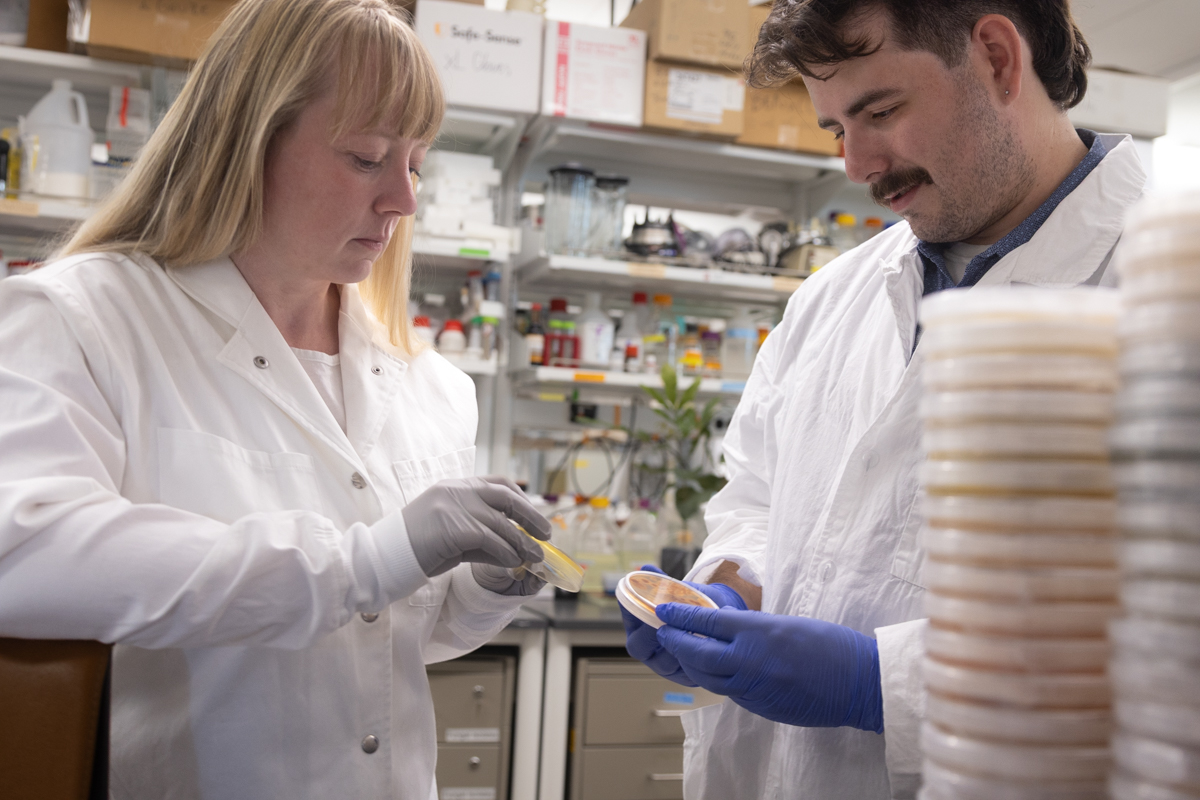
The 2026 mentorship award is shared by Trine Anderson and Brandon Kristy, Michigan State University scientists who have helped numerous students on their own path to careers in science.

Instilling a passion for research
Anderson, a senior scientist in Bjoern Hamberger’s lab, mentors at least five undergraduate students at different levels, fostering an environment for safe learning where the students can have hands-on science experience.
GLBRC Science Director Sarah Lebeis, one of several MSU faculty members who nominated Andesron, said Anderson actively includes graduate students in research and manuscript writing while providing hands-on experience and confidence building for undergrads.
“Even more striking is how clearly Trine has instilled in them her passion for research,” Lebeis said. “Her enthusiasm is not only contagious but clearly shapes a supportive and intellectually vibrant lab culture.”
Anderson’s mentees have gone on to receive departmental awards, Dean’s Research Scholar recognition, competitive internships, and full-time positions.
James Suggit, now a medical student at New York University, said Anderson made him feel at home in the lab and “was instrumental in generating the competencies and confidence necessary to take on my own independent project, and has tirelessly advocated for me since.”
Tyler Criss, a genetics research scientist with Pfizer, said Anderson’s support helped him gain confidence in biochemistry and overcome a “rocky start” at MSU.
After joining the lab as a first-year student, Liam Clark is now working on an honors project investigating the role of a bacterial shell protein he discovered.

Anderson’s favorite part of mentorship is watching students like Clark grow.
“You start maybe with somebody who's very shy,” Anderson said. “And then half a year later, they’re way more confident… I get so happy when I see that it's working out for them, and they’re just blossoming.”
Fostering confidence
As a PhD candidate in Sarah Evans’ lab, Kristy focuses on using soil microbes to make nutrients more available to crops, which would enable farmers to use less fertilizer.

GLBRC Co-investigator Greg Bonito said Kristy sought out the opportunity to mentor undergraduates even though it wasn’t a requirement.
“Brandon demonstrates exceptional commitment to mentoring through intentional preparation, sustained engagement, accessibility, and leadership within the GLBRC mentoring community,” Bonito said.
Lana Wheatley said Kristy has helped her develop the confidence to pursue graduate studies in microbial ecology, challenging her while ensuring she wasn’t overwhelmed — all while managing his own workload.
“Despite working late hours in the lab, hosting last-minute tours of Kellogg Biological Station, and now preparing to work at the Lawrence Livermore National Laboratory, he’s always made time to meet and help me troubleshoot,” Wheatley said. “I cannot imagine how different my research path would have been with a different mentor.”
Alassane Sow described Brandon’s mentoring style as one that “encouraged troubleshooting and making mistakes,” noting that learning from Brandon made him “excited to do it on my own.”
Kristy said he’s grateful for the guidance he received throughout his own academic journey and now wants to “pay it forward.”
“Growing as a scientist involved being pushed out of your comfort zone,” he said. “All of the mentors I had gave me an environment for me to explore my interests, and, more importantly, to make mistakes and figure things out on my own.”