
GLBRC alumni profile: Caro Córdova
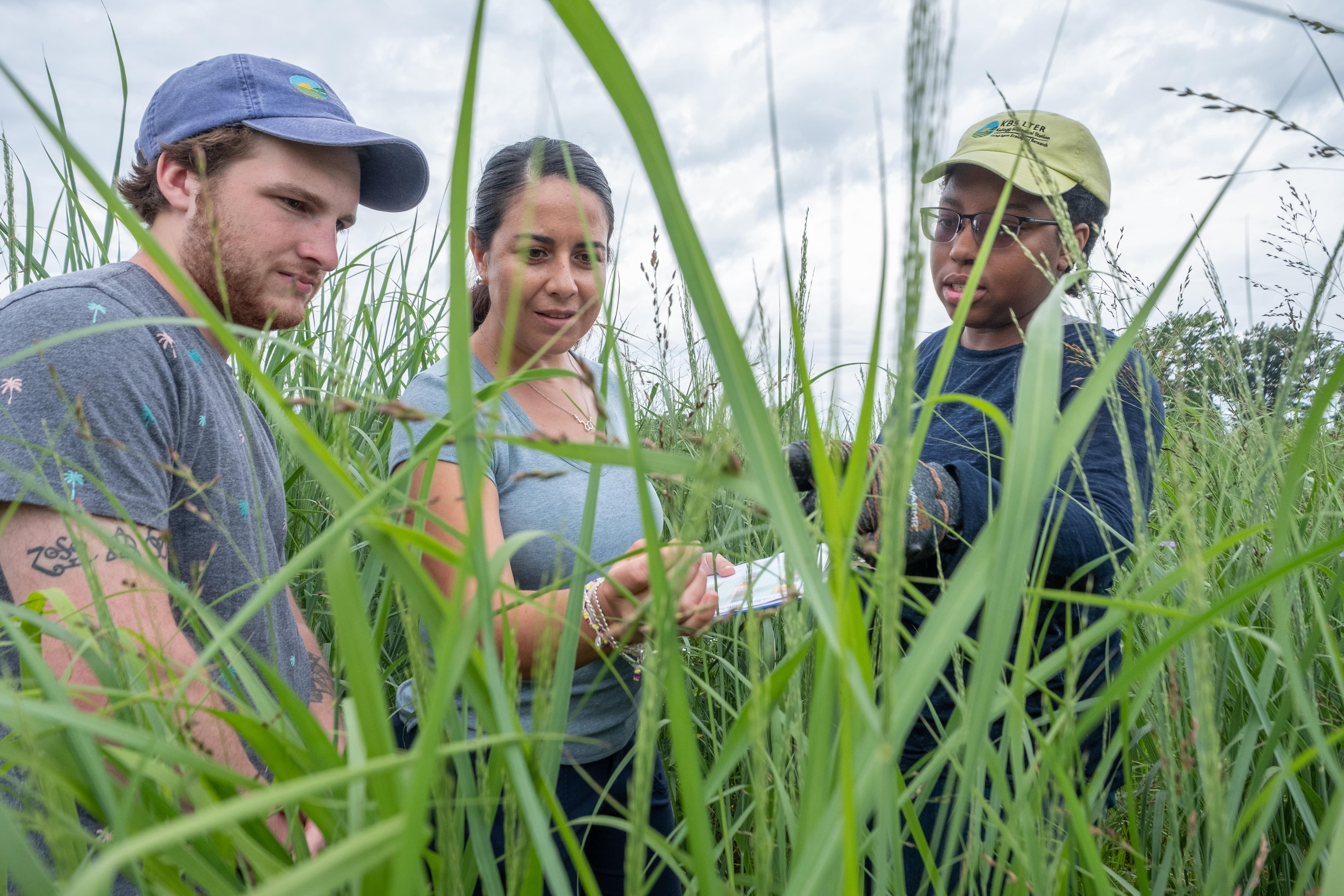
What was your main research focus at GLBRC?
I worked with the sustainability team, so we were studying the environmental performance of bioenergy crops. Studying how much organic carbon can bioenergy crops sequester? How much nitrogen can they fix? So for example, we studied the nitrogen fixation in switchgrass. There was a missing nitrogen amount that we came across that definitely was coming from the association with free living nitrogen fixers. We were able to quantify that part and confirmed previous work done by former postdoc Sarah Roley. So looking into those aspects that make these crops more sustainable in terms of the whole process producing biomass, but also in terms of being resilient and low input crops.
On top of being a postdoc working with Phil Robertson, I was a field research coordinator. So I was the gatekeeper of all the GLBRC field sites in Michigan, and in Wisconsin, too.
The research fields that I worked on directly in Michigan were the bioenergy research plots – the BCSE, the biofuel cropping systems experiment – and the switchgrass variety trials plots. I was able to help start a new long-term field experiment with testing new switchgrass varieties. And then also working on ideas for bringing in new sorghum varieties from some collaborators from Iowa State. Because the ones that we were working with at the time that I was there were from Texas. So I was able to prove that the ones developed and improved in Iowa State were more suitable for the conditions that we have up at 42 degrees latitude north. So that was great – being involved in several projects and also bringing ideas to the team and connecting with other faculty that I worked with while I was a graduate student at Iowa State. It was great that new research ideas were welcome.
Because KBS was not only connected with the GLBRC but also with other networks, it was a great opportunity for me to grow as an early career scientist.
What is your current role?
My job involves leading various initiatives throughout the state of Nebraska. It’s not fundamentally tied to research, but extension and teaching. But that hasn’t prevented me from doing research.
My experience working in different environments and cropping systems has allowed me to expand soil health not only in croplands, but in forest, grasslands, and rangelands. And now I'm expanding my work into urban areas, because the expansion of urban farming here in Nebraska is big. The farmers markets are really expanding. What worries us is that many people think that any backyard can allow them to produce good and healthy vegetables. We are worried that people have good intentions but don't know much about soil science, and whether their soil is suitable for growing crops for direct consumption. We are building educational programs for people that don’t have an ag background, guiding them on how to test their soils and determine if it is suitable for growing food or not.

This year I was invited by the National Academies of Sciences to come to Capitol Hill to inform them about the current status of soil health, how we are training people, what are the main concerns, and how could we better tailor the programs and fund that type of research. It was more with an advocacy objective.
I have to tailor my program for policy makers, for middle schoolers, for producers, or public health (experts). Community health starts with healthy soil. In Nebraska we are dealing with some environmental issues. Water quality is one of them, and the problem starts with the mismanagement of soil.
You mentioned you also do research. What projects are you working on?
I partner with different faculty here at UNL, and we are expanding the soil health assessment framework into different ecosystems. We just did a post-fire assessment of the national Sandhills here in Nebraska. That is a totally unmanaged system. Some parts have native grasslands, but some other parts were handmade woodlands. Like in the (Nebraska National Forest) at Bessey, they planted Eastern red cedar and ponerosa pine trees. Eastern red cedar is an invasive species that is attacking and taking over the Great Plains. Back in the 1900s, both species were planted just to have timber for the railroad and early settlers, as well as to create windbreaks in an otherwise treeless prairie landscape. This place serves as a natural laboratory to study the dynamics of invasive species and also how these different ecosystems (native grassland and woodlands) overcome these big and rapid impacts from wildfire. We want to know which of these ecosystems recovers faster from a wildfire, and which one is more resilient? How long does it take, and so on? We have been doing a post-fire soil health assessment for over three years now, since the Bovee fire in 2022.
On top of that, we have been testing different spectroscopy technologies that allow us to do high-throughput evaluations of different soil properties, and also how we could adopt these new technologies into robotics. Ag engineers laugh that we are still collecting soil samples by hand. I’m working with them on testing new technology to make soil health assessment fast and also cheap for everyone to adopt. Because here the farms are big. The average farm could be 700 to 900 acres. So if you ask them to do soil sampling, it’s going to be costly, time consuming. That's something that we are trying to improve and guide them in adopting more technology into their fields.
How did your postdoc experience prepare you for this type of role?
The GLBRC experience equipped me with practical tools for effective system management. Working as part of Imulti-disciplinary teams helped me broaden my perspective and taught me the value of integrating diverse expertise to address complex challenges. In this approach, each team member contributes a crucial piece to the puzzle.

The sustainability aspect – I’ve learned that not everyone is receptive to terms like “soil health” or “resilient systems.” But if I come in talking about the basics and using concepts that they do like to hear – for example, fertility or organic matter – those kinds of things really ring a bell to them. Engaging with scientists with different backgrounds gave me the confidence to tackle these parts and have those concepts always present. It’s about being creative in how to narrate the stories or connect the dots for producers to see it in a way that they are familiar with.
What's something that you wish you had known when you came out of grad school?
The 10% of my staff position as a field research coordinator was a big jump for me, coming from just managing a few undergrad students in my project going into being the gatekeeper – you know, saying No to someone because what they're proposing for sampling is too aggressive, it made me nervous. But with time, my confidence grew and also everyone knew that I was just trying to protect the sites for longevity.
That experience allowed me to advise UNL department heads on how to manage their long-term sites, as most of these sites haven’t kept track of the data collection in a digital format. GLBRC has a great data catalog and also a system that allows all researchers to request permission to use the land, but also keep track of who is doing what and when, and whether it is aggressive or not aggressive, and also connects people who have already done those measurements – a better organization of all the information. That was something I really appreciated. GLBRC and KBS set the standard for me to use here at UNL.
What advice would you give to a recent graduate who's looking for their first postdoc and maybe considering GLBRC?
It’s a great opportunity, not only to strengthen scientific skills, but also to learn beyond one's own subject. Be open to learning from A to Z. GLBRC provides opportunities to go beyond their lab, and the co-investigators have an open-door policy. Whenever I had questions related to other topics, I was able to shoot an email and have them on board to collaborate or provide feedback or information needed, which really helped guide me to execute great ideas. That’s a great opportunity.
GLBRC has a great mentoring program that doesn't leave anyone behind. I was at Michigan State, but I didn't feel like a stranger to people at UW. I'm still engaging in different activities with you guys. So the connection is not destroyed after someone leaves the nest.