
News
Sustainable Biomass Conversion
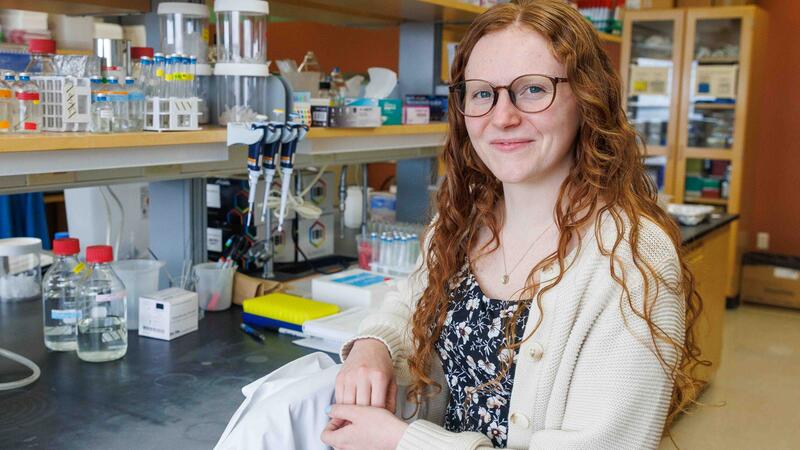
Sparking Curiosity: Sydney Bradley uses art to make science more accessible
As a graduate researcher at the University of Wisconsin–Madison, Sydney Bradley studies microbiology in pursuit of better biofuels. But she’s not just interested in publishing her findings in scientific journals.
Great Lakes Bioenergy Research Center co-investigator John Ralph has been elected to the National Academy of Sciences, one of the highest honors a scientist can receive, in recognition of his research accomplishments.
GLBRC investigator Holly Gibbs is among five University of Wisconsin–Madison faculty members elected to the American Academy of Arts & Sciences. As a geographer, she studies how and why people use land around the world and what these changes mean for the future of our planet.
Rebecca Smith uses genetic tools to develop plants that can be digested more easily. The outcomes could be greater efficiency for biofuel production and lower methane emissions from dairy cows.
Fong Liew is a graduate student in Brian Fox’s biochemistry lab, where she works in collaboration with Tim Donohue’s bacteriology lab on converting lignin, one of the main components of plant cell walls, into valuable industrial chemicals.
GLBRC researcher Brandon Kristy from Michigan State University has won a prestigious Department of Energy fellowship that will allow him to study mutually-beneficial relationships between plants and microbes at the Lawrence Livermore National Laboratory.
Researchers tested a bioreactor system to process aromatics from poplar trees with a modified strain of Novosphingobium aromaticivorans that releases a chemical known as PDC while accumulating two other products inside the cells: a natural pigment and a vitamin-like substance found in most human cells. PDC can be used to make plastics, while the other products are used in nutritional supplements, cosmetics, and animal feed.
Building on previous work using RCF to deconstruct poplar, Great Lakes Bioenergy Research scientists evaluated six solvents in pure form and in varying mixtures with water and used the results to develop a computational model for solvent selection. The results showed a 50/50 mixture of methanol and water performed the best because it reduces reactor pressure and doesn't interfere with the microbes and lowers the break-even cost of the product by 24%.
Bacteria and other microbes can convert plant fibers into sustainable fuels and chemicals used to make plastics, medicines, and other products. But chemicals used in processing or in the plants themselves are an obstacle because they can kill the cells or slow fermentation. Researchers are looking for ways to modify natural efflux pumps to selectively remove these toxins, but testing the vast number of possible variations is impractical using traditional lab techniques. Data generated for this project are being used to train artificial intelligence models to predict which mutations are most likely to be effective.
An autonomous experimentation platform at the Great Lakes Bioenergy Research Center is poised to accelerate discoveries that will harness the power of microbes to advance U.S. leadership in the developing bioeconomy. With the ability to design and run multiple concurrent experiments, Proteus expands the scope and pace of exploration, potentially increasing the rate of discovery.
Switchgrass and miscanthus are considered good bioenergy crops. They can grow on lower quality lands not used for food production, add carbon to the soil, and be converted into fuels and chemicals traditionally made from petroleum. Scientists have observed that these grasses produce high yields for a few years and then begin to decline; but they don’t fully understand why that happens. Using data from bioenergy crop experiments in Michigan and Wisconsin, scientists with the Great Lakes Bioenergy Research Center analyzed more than 200 plantings of switchgrass and miscanthus to better understand long-term yield patterns and what drives them.


